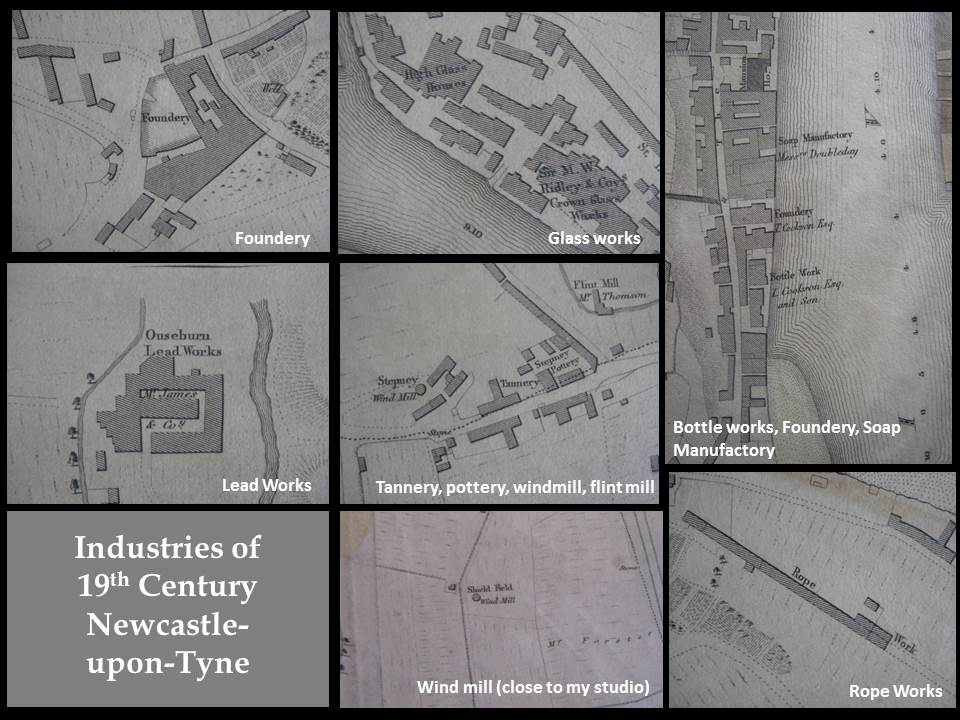
Newcastle upon Tyne; a new town in the old town

Rope-makers
Oil yard
Glass works
Paper mill
Foundry
Coal pit
Lime kilns
Pottery mill
Lead works
Soap factory
Bottle works
Lunatic asylum
Poor house
Tannery
Fever house
Baths
…and windmills aplenty.

It doesn’t sound like Newcastle city centre, does it? Yet a beautiful map from 1827 which was brought to the studio for treatment tells a very different and fascinating story of the city. Many of the now-renowned streets such as the famous Grey Street weren’t yet built but instead, fields were in their place. Small industries were dotted all over the town, giving it an energetic and industrious feel. Most incredibly, a river with gardens and wooded areas where Victorians would stroll and ‘take the clean air’ ran along the route of what is now the central motorway – populated only by speeding cars and derelict concrete buildings.

After receiving the map, I walked the streets of Newcastle with new eyes. The street names made a ‘new’ sense, I saw what wasn’t there and, although admittedly the modern achievements were great feats of engineering, I wish we could learn lessons from such destruction of our heritage.

The Ouseburn area is one of the few areas of Newcastle which has retained and repurposed many of its old buildings and is definitely a jewel in Newcastle’s crown. Well worth a visit.
Slide1

Posted in From the studio | 1 Comment

Happy Birthday, Zoe Finlay Paper Conservation!

I’m delighted to report that today is the second birthday of of Zoe Finlay Paper Conservation.

Thank you to all my customers who have brought me some wonderful objects this past two years. Your support and interest in paper conservation is invaluable and I look forward to seeing many familiar faces and meeting new customers in the coming year.

All the best

Zoe

Me - March 2013

Posted in From the studio | Leave a comment

Chinese Woodblock Printing

I’m extremely excited as I’ve just booked myself onto ‘Chinese Woodblock Printing’ , a 3-day course held at the Botanic Gardens, Edinburgh.

I love the immediacy of woodblock printing. The simplicity of using hand-held tools to interact with a beautiful, natural material, taking into account grain direction and characteristics makes it probably my favourite printmaking method.

The centuries-old process of Chinese woodblock printing is of major importance in the history of the development not only of art but essentially of the printed word. To use the traditional tools and materials while learning about the history and development of the process is going to be fantastic.

If you’d like a brief but fascinating insight, here is a video I’ve found: http://www.youtube.com/watch?v=y57rUeCHoXg

Posted in Events, talks and activities, From the studio | Leave a comment

Bringing the North East’s Engineering Heritage Back Home (Tyne & Wear Archives)

This is an interesting article about preserving records which relate to the North East’s vast industrial heritage. Many of these plans will be a beautiful and precise drawings made painstakingly by hand. And just look at their sheer scale!

http://www.twmuseums.org.uk/engage/blog/bringing-the-north-easts-engineering-heritage-back-home/

Posted in Media articles of interest | Leave a comment

Preserving Family Photographs

I’ve spent my last few evenings finally sorting through some piles of old family photographs that I’ve been meaning to deal with for a while.  As many of my ancestors are untraceable and I have only scant information about a few, you can imagine my delight when I came across a group photograph from an Edwardian wedding.

From the typical placement of family members in wedding photographs coupled with facial similarities, I can make pretty good educated guesses as to who was who.

So while I may not even know some of their names, I now at least have a photograph of them. And I want to make sure I take really good care of it! I’m using only archival materials in my album and will have to consider where it is best to store it,  well away from  sources of heat and damp.

If this sounds familiar to you and you would like further information on the storage and display of photographs, contact me for some advice. I also recommend following this link:

http://www.nedcc.org/resources/leaflets/4Storage_and_Handling/11StorageEnclosures.php

If you would like to contact a photograph conservator, drop me an email and I will forward you details of several who may be able to help.

Posted in From the studio | Leave a comment

Reuters; Not reading from the same page…

Quite how Reuters can one day confidently report that Timbuktu libraries have been torched, ( http://uk.reuters.com/article/2013/01/28/uk-mali-rebels-idUKBRE90P0A120130128and) and then two days later report that they haven’t been torched and the majority of manuscripts are in fact safe is a little baffling. It does sound as if a small number of manuscripts have sadly been burnt, overall the below article is a far more positive turnaround:

http://uk.reuters.com/article/2013/01/30/uk-mali-rebels-manuscripts-idUKBRE90T0I020130130

Clearly, while new information has since come to light, it’s a shame that so many media sources reported news of such devastating actions based on unconfirmed reports.

Posted in Media articles of interest | Leave a comment

Timbuktu’s Missing Manuscripts

If, like me, you have found it heartbreaking to hear the news of the supposed destruction of Timbuktu’s ancient manuscripts, (or MSS), then you may be interested to read the below two articles which give a slightly different, and perhaps more informed, view to those reported in our national press.

Whilst undoubtedly there has been some destruction, certainly of this valuable collection as a whole, quite how much destruction has been carried out still remains unclear, with no confirmed reports. Several other theories on the whereabouts of the missing MSS are proposed.

Well worth a read.

The Guardian: http://www.guardian.co.uk/world/2013/jan/28/destruction-timbuktu-manuscripts-offence-africa

Other Sources:

http://www.theglobeandmail.com/news/world/priceless-manuscripts-missing-in-timbuktu/article7903879/

http://www.theatlantic.com/national/archive/2013/01/did-timbuktus-priceless-archives-really-just-get-wiped-out/272658/

Posted in Media articles of interest | 1 Comment

January Newsletter

The first newsletter of 2013 is now available! Please click on the following link:January 2013 Newsletter

This issue includes an article prompted by ‘National Writing Day’ in the US, as well as a brief overview of the eye-opening variety of materials which paper makers have experimented with over the centuries.

There is also a look at the fascinating subject of ‘Book Burning’. It is amazing how influential such incidents have been throughout the history of many countries. I hope you enjoy reading about it.

Don’t forget to email me if you would like to be added to my mailing list to be sent future copies. Previous issues can be found by going to the ‘Newsletters’ page on this website.

Posted in Newsletter | Leave a comment

Put the kettle on and settle down

What with all this snow we’re having, you may be foregoing your keep fit class, countryside walks or just looking for an excuse to not leave the house!

So here are two very good excuses..

If you didn’t see them the first time around, there were recently two excellent television series which are still available on BBC IPlayer. ‘Illuminations; The Private Lives of Medieval Kings’ examines the history and the making of some of the beautiful manuscripts which are normally hidden in the depths of the British Library.

http://www.bbc.co.uk/iplayer/episode/b0192nrg/Illuminations_The_Private_Lives_of_Medieval_Kings_Ruling_by_the_Book/

The second series I would recommend is ‘A History of Art in Three Colours ‘  (Blue, Gold and White). I really enjoyed this series which examines the history and use of pigments, (one each programme). They were presented by the prominent Cambridge/Yale art historian, Dr James Fox, who is clearly very passionate about his subject.

The final programme, ‘White’ left me slightly disappointed at first as it spent a good chunk discussing the architecture of Le Corbusier and Mussolini and the passion for white which both these men shared, rather than the pigment history I had hoped for. However, it unfolded to be a fascinating programme. If you can forgive the repeated, (and rather unnecessary) shots of James posing moodily against a sun-baked wall, I really recommend it.

http://www.bbc.co.uk/iplayer/episode/b01lcz2s/A_History_of_Art_in_Three_Colours_Blue/

I hope you enjoy them!

Stay warm.

Posted in Media articles of interest | Leave a comment

January Newsletter – available soon!

The January newsletter will be available this Friday. Check back to this blog on Friday morning for a link or keep an eye on my ‘Newsletter’ page on this site.

If you’d like to be added to the email circulation list, please send your email address to: zoe.finlay@gmail.com

I will never pass your details onto anyone else nor send you additional emails in between the quarterly newsletters, (let’s face it, we all have enough in our in-boxes, don’t we)? You may also unsubscribe at any time.

Posted in Media articles of interest | Leave a comment