I’m pleased to say my latest newsletter for January 2012 is now available on this website.
Thanks to everyone who has passed me their enthusiastic comments about it. It seems to have captured quite a few people’s interest!
I hope you enjoy it.
I’m pleased to say my latest newsletter for January 2012 is now available on this website.
Thanks to everyone who has passed me their enthusiastic comments about it. It seems to have captured quite a few people’s interest!
I hope you enjoy it.
The first of three open days for 2012 is now scheduled for Sunday 11th March, 10am to 5pm.
I plan to be there to answer any questions you may have about conservation or objects you are worried about. I won’t be opening my studio for security reasons but I will have a small display near it to show examples of treatments and some of the materials used in paper conservation.
Hope to see you there!
I met a very interesting gentleman today who it turns out once restored part of the ceiling of ‘Downton Abbey’, the castle featured in the very popular current TV drama of the same name.
This famous castle near Newbury goes by its real name of Highclere castle and dates back to 1842, although the owners, the Canarvan family, can lay claim to owning a castle on the site since 1679. While reading about it, I came across this article, published by the Telegraph in 2010:
It seems the popularity of the TV series has helped to save the castle with various restoration projects currently underway.
In an age where our nation’s castles, stately homes and arts heritage in general are all suffering such difficulties, it is heart-warming to hear a good news story. A quick look on the castle’s website reveals they are now inundated with requests for visits. Long may it continue.
This is a really interesting article about the impromptu maths notes that were crucial for the safe return of the Apollo 13 space vessel in 1970. When things went awry, it was these calculations that meant the crew and shuttle were saved.
http://gizmodo.com/5863778/the-math-that-saved-apollo-13
It’s amazing to think that we can now read these carefully worked out calculations which were to make the difference between success and total disaster. It’s no wonder that James Lovell wanted his arithmetic to be double checked!
The notes were recently sold at a US auction for $388,375 (approximately £249,807).
I love the fact that often these brief moments in our history, written on poor quality paper with fading modern inks and made purely for utilitarian purposes can end up holding so much significance for future generations.
Over the Christmas period the studio will be closed from Monday 19th December until the end of the year. I will still be checking my emails every day, (okay, maybe not Christmas Day!) so if you have any questions please do still call (07906 334 002) or email me (zoe.finlay@gmail.com) and I will be happy to answer them.
I’m looking forward to taking my studio forward into 2012 and to seeing lovely new objects that I know are heading my way once the holidays are over. The next newsletter is due out at the end of January, the Tynemouth Antiquarian book market will resume in April and I am looking forward to increasing my capacity to house solvents, meaning I can offer an even better service to my customers.
Until then, we get to cosy up while the snow falls and look forward to a beautiful spring!
I hope everyone has a great Christmas and New Year, Stay safe in the snow and ice and I’ll see you in 2012.
Zoe
Oh dear, I’m afraid something has cropped up and I’m not able to take part in the Ouseburn open studios this forthcoming weekend.
Still, it should be a great weekend so if you’re going, I hope you enjoy it! As for the free bus, it is running all weekend between the venues. Bus stops should be clearly marked, but the best way is to ask at the first venue and they should be able to give further information.
For more information on what’s on show, please see the website: http://www.ouseburnopenstudios.org/news
‘Coated paper’ refers to the smooth often shiny paper we most frequently see in glossy magazines, some books (particularly those which contain printed plates) and graphic novels.
The surface of coated paper owes its qualities to the addition of either clay, (kaolin), calcium or barium sulphate. These are mixed together with either glue or casein, both of which help to bind the clay to the paper surface. The finished paper is then calendered (or ‘polished’) to create either a matt, glossy or smooth surface which together with the minerals has a natural affinity for pigments and dyes such as those which are used during colour lithographic printing.
So why does coated paper stick together so much once it has been wetted and dried? If we recall what happens when clay dries and then water is added, what results is a substance that is sticky when wet and crumbly and hard once dry. If we factor in the addition of glue it is unsurprising that the surface of coated pages tend to stick together and set almost like a concrete block. In addition, stains embed themselves within the paper.
When separation is attempted the paper, (usually weak with thin, short fibres) can’t resist the force required and the paper then fragments with paints and inks tending to cleave at the coated surface. Wetting only encourages the glue effect to return and drying results in crumbling when separation is attempted. That often spells a big problem for the conservator!
Let’s look at an example…
Recently, two graphic novels arrived at the studio, each of which had the lower third of their pages completely stuck together after being beneath a leaking roof. Each page was set into a solid block and while fortunately the pages of one novel came apart with very little damage, the second novel was far more problematic. Typically, the pages crumbled with each attempt at separation. Eventually, the pages were separated though with considerable damage. Even the smallest of fragments were saved and re-pasted wherever possible but the lost areas of each page had to be ‘rebuilt’.
While normally in conservation the approach of ‘first do no harm’ applies, this object was neither rare nor unique and the client fully understood the consequences of separation before treatment began. Balancing the reality that the graphic novel could never be opened ever again and did not fulfil its original function, the treatment proceeded.
Whilst the pages separated, the treatment resulted in large losses. However, these losses were successfully infilled with Japanese repair papers which were selected based on their empathy with the original surface texture, weight, colour and strength of the pages. Once finished, the pages were stronger, the severe distortions flattened and the graphic novel was fully useable again.
It can never be accurately predicted how well coated paper can be separated until treatment begins but the good news is that with the application of care and the correct materials, successful results can often be achieved.
For those of you who may not know, Ouseburn is an area of Newcastle which has a very high proportion of artists’ studios, galleries and workshops, (not to mention design businesses, bars and live music venues). Basically, this hub of creativity flings open its doors once a year and the Ouseburn Open Studios is confirmed to take place on Saturday 26th and Sunday 27th November 2011, 10-5pm both days.
Many studios will be open with artists on hand to chat and give workshops and demonstrations to the public. It affords a valuable and interesting insight into all kinds of creative businesses and ventures with artworks for sale and family events. Last year, 6,262 people visited the event in just two days. At the time of writing, the free bus which connects up the studios is in the planning stages and once it is confirmed I will let you know here.
I will be in the Biscuit Tin Studios, probably with a small display aiming to increase awareness and understanding of conservation. For security and safety reasons I’m afraid I can’t allow access to the studio but hopefully I can answer any questions you may have about paper conservation.
I hope to see you there for a fun (and free) weekend!
Someone recently asked me: “How much is an artwork re-touched during conservation treatments?” I’m afraid there’s no simple answer to this often hotly-debated subject.
And that’s a very good thing.
The answer is, and always should be, influenced by factors such as the artwork itself (what it is, who it is by, its history and current condition etc.) and future intentions for it (museum/library/gallery display or storage, limited or full access for the public or for private enjoyment at home), as well as the desires and viewpoints of the conservator and the client.
So…it all gets a bit complicated! However, it is a positive thing that the ethics of re-touching (often referred to as ‘inpainting’ in the US), are constantly being examined and that there’s scope for a flexible and unique approach for each object. Let’s take a brief look at an example:
A fifteenth century painting was damaged by a fire that occurred during the seventeenth century. During the nineteenth century, a restorer decided to remove the darkened layers of varnish on the painting and paint in the missing areas with what he/she believed should have been there.
Several questions arise from this fictional account. Firstly, at what point is the smoke damage simply part of the objects’ history? Is it right that it should be cleaned off? After all, conservation seeks to preserve historical evidence and this is an event that occurred during the painting’s history, possibly even a fire of historical significance itself. Secondly, should the restorer’s additional paint be removed? It may be obscuring the original paint layers below and alter the meaning of a painting with inaccuracies (for example, covering nudity or altering symbolism and proportions).
There are no right or wrong answers to the scenario, but a conservator would bear in mind both the chemical damage that the dirt may be causing to the painting and the need or desire for viewers to enjoy the object as a work of art. A decision will also be taken as to whether removal of the added nineteenth century paint layers is appropriate. These days, additions or repairs are often made in a slightly lighter tone so they can be differentiated yet tone in. This can minimise disruption that untouched losses could otherwise cause.
In summary, conservators carefully weigh up the pros and cons, often in consultation with others, and reach a decision to the best of their ability as to ‘how far is too far’.
If you’d like to read more on this subject, I can recommend the following two books:
I’ve recently been carrying out conservation on some items from a wonderful collection of ephemera which included all sorts of interesting items, one of which I’ve picked out for you on this blog page (see the Portfolio page for treatment information and photos coming very soon).
This item was a particularly lovely find for two reasons. Firstly, it includes a contract dating from 1829, (first photo) drawn up to settle the building of a bridge at the river Tyne near the area of Scotswood in Newcastle upon Tyne:

Also included is a pen and ink drawing on transparent linen of the proposed bridge (below). For some reason, the bridge was never built and it is possible that this document is the only evidence of the original plan.
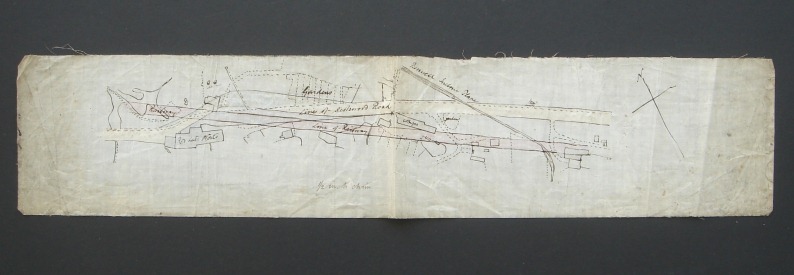
The second reason I have included it here is because it is a perfect example of the historic use of transparencies, a subject I am very interested in. Imagine how important such architectural drawings were before the days of the photocopier or printer! It’s very common for transparent papers or linens (linens impregnated with oils, resins or waxes to make them transparent as in this case) to show signs of heavy usage as they were used outdoors on buildings sites, folded into pockets and no doubt passed around a lot as an invaluable reference tool.
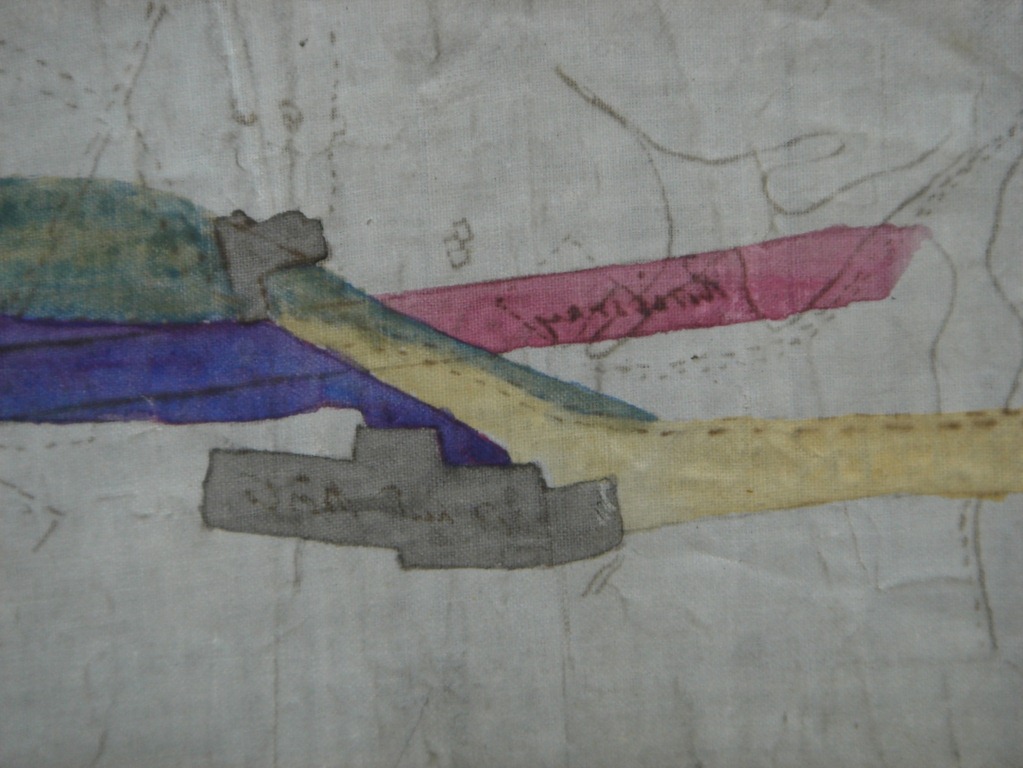
Inks were often applied onto the back of a transparent paper/linen. In the below two photos, compare the front (“recto”) image and the reverse (“verso”) of the same area. Note the vibrancy of the colours on the back where they have had increased protection from abrasion, light and dirt as opposed to the fading we can see on the front, although it is unlikely the front was ever intended to be quite as bright as the back:

There’s a wealth of interesting literature on transparent papers from early preparation recipes to contemporary methods of conservation treatments. If you would like to know more, please email me at zoe.finlay@gmail.com and I would be happy to forward you some links to further reading.
 Zoe Finlay Paper Conservation